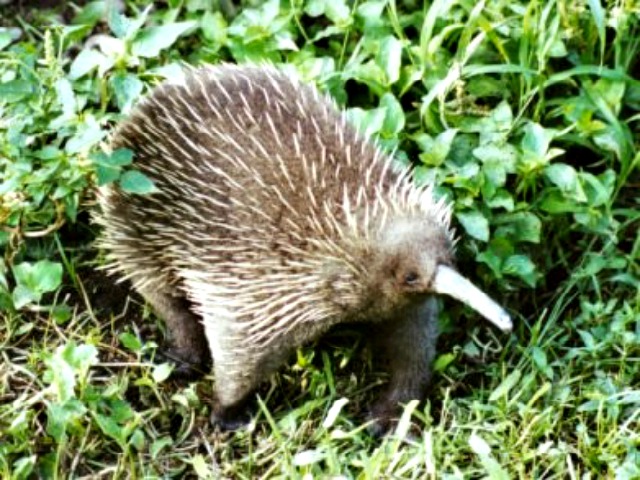
Long-beaked Echidna Facts!
Long-beaked Echidnas are found in New Guinea and are egg-laying mammals known as monotremes, the duck-billed platypus and the short-beaked echidna are also examples of monotremes.
Echidnas’ Spines

On its back, sides and tail there are spines interspersed with its fur. The spines can be erected when threatened. If the echidnas are on soft ground they can burrow down to protect the underside which doesn’t have any spines but on hard ground it can roll into a ball like hedgehogs. They are solitary animals and are also nocturnal. They take refuge in burrows, cavities in the ground or in hollow logs during the day.
Echidnas’ Diet

The echidnas have strong claws that enable them to dig and search for food. Their diet consists of almost entirely earthworms though they are sometimes referred to as spiny anteaters. Ants, termites and other worms also make up the echidnas’ diet. The echidnas’ tongue has spikes at the front which are used as a “hook” to catch prey. Using the long snout they probe around until a worm is found and then stick the tongue out to hook the worm in the spikes. The echidnas then retract the tongue in to the mouth along with the prey.
Reproduction
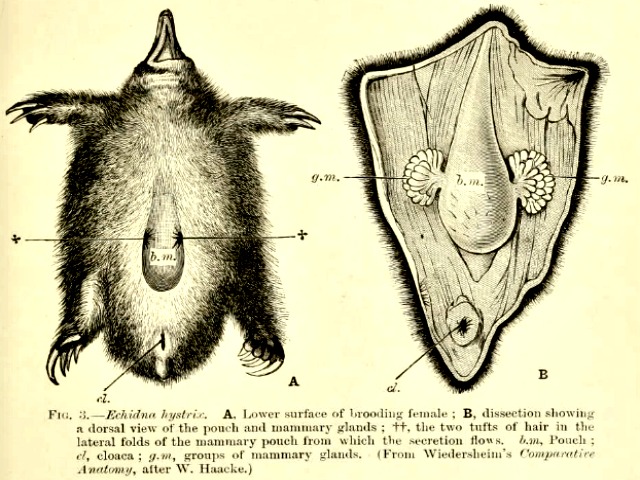
Usually a single egg is laid into the female echidna’s pouch. The egg hatches after 10 days but the baby remains in the pouch and feeds on the mother’s milk for around 6 months until its spines develop. The female echidnas do not have teats; the baby laps the milk from “milk patches” in the pouch.
Long-beaked Echidnas are featured in this following book:
25 Weirdest Animals in the World!
Long-beaked Echidna Videos
Long-beaked Echidna at Taronga
Close-up footage from Taronga Zoo in Sydney of the Long-beaked Echidna.
Echidnas in Tasmania
Adorable look at some little echidnas with an informative talk from a keeper.
Echidna journeys
A short-beaked echidna having a good wander, snuffling for tuck and having a scratch.
You can find videos of the short-beaked echidna here.


